
77 AD
Reflections of our own image had a magical significance in ancient cultures. In early times glass polished stones or metal were used. The Romans coated flat glass with silver or gold foil.
Justus von Liebig discovered the chemical process of coating a glass surface with metallic silver in 1835. Today, mirrors are still made by coating a thin layer of molten aluminum or silver onto the back of a plate glass in a vacuum. However, mirrors and their capabilities are still evolving.
During the Renaissance, Nuremberg and Venice became centers of excellence for mirror production but by the middle of the 17th century mirror making was practised extensively in London and Paris. The Royal Palace of Versailles had incredible mirrors in the staterooms, which created a sensation at the time.
The mirror is a reflection of personalization and how important this strategy has been throughout civilizations. Whether an Ancient Egyptian buyer was looking at a reflection in polished bronze or today’s shopper is looking at a digital mirror that allows color and patterns to change at a click, the mirror teases the ego and influences almost every purchase decision.
Contribution to Retail History
Craftsmen such as Grinling Gibbons in the late 17th and early 18th centuries produced elaborately carved mirror frames, and Scottish brothers Robert and James Adam created ceiling-high fireplace units that used mirrors to create a special ambience.
As the 19th century progressed, mirror making became cheaper and mirrors were put into wardrobes, sideboards, and clothing retailers began installing them in and around store interiors and in changing and fitting rooms. Three-way mirrors were also introduced to help customers see themselves from different angles when trying on clothes.
Today, mirrors are taking on new dimensions as digital technology begins to extend their capabilities for retail use. For example, interactive mirrors in stores incorporate a camera which captures the customer’s body dimensions and stance. Using hand gestures, the customer ‘swipes’ different outfits from a display menu and the mirror shows their reflection with the selected garment superimposed over their on-screen image. The digital delay mirror records the customer’s reflection and outputs it on a two second delay, enabling them to see what they look like from the back.
See where this object sits in the sweep of retail history →
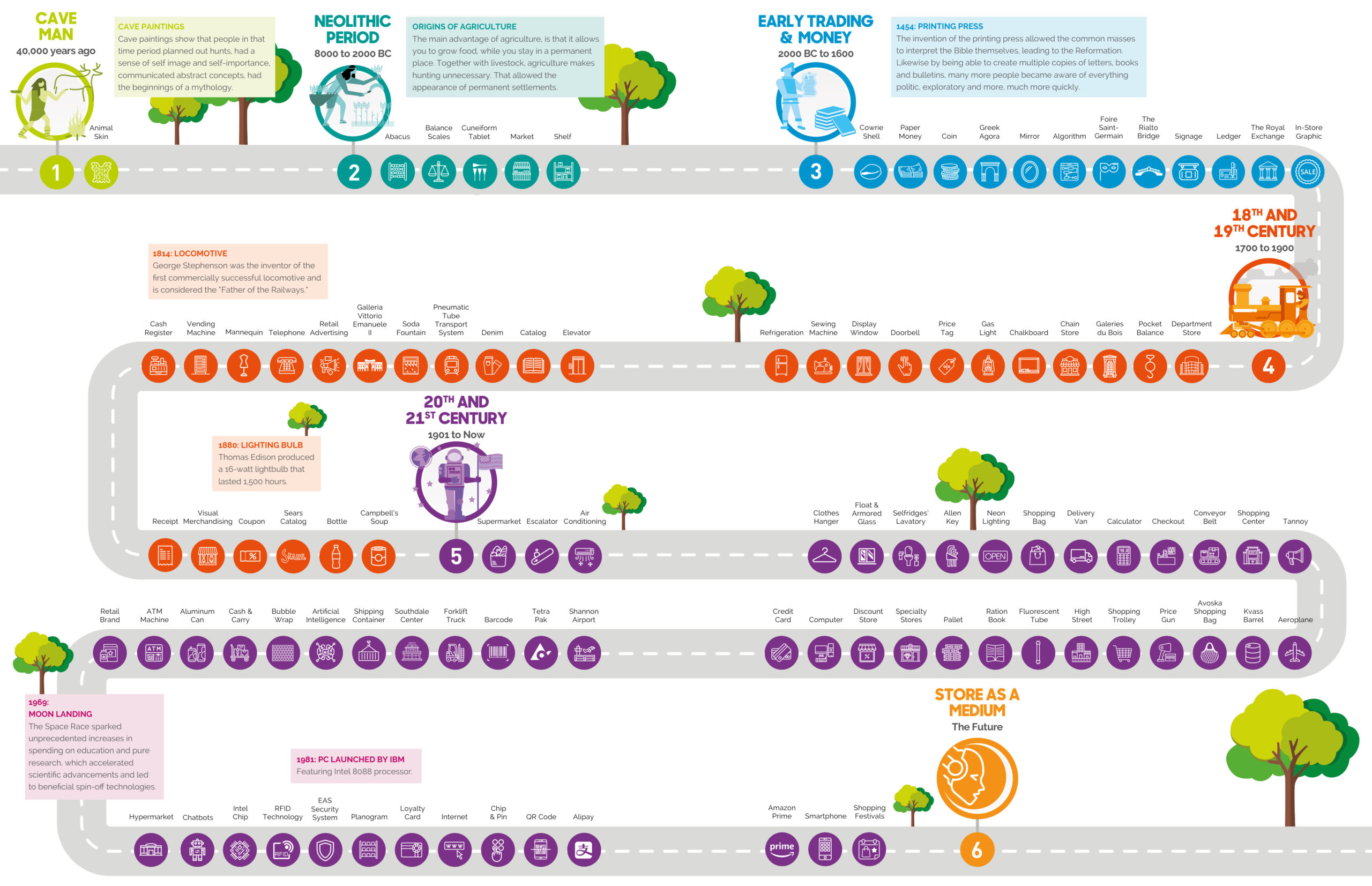
About the series. The History of Retail in 101 Objects is compiled and edited by David Roth, CEO of The Store WPP and Chairman of WPP BAV. It tells the story of retail through the objects that shaped it, from the cave to the connected store, organised across the historical periods in which each innovation made its mark. As David puts it, the history of retail is the history of mankind, and of retail’s vast contribution to society. A new object appears here every Monday.
This is the fourth edition, the World Retail Hall of Fame edition. The book, and every object published so far →