
2000 BC to 1600
The 9th century Persian astronomer and mathematician Muhammad ibn Musa al-Khwarizmi was responsible for the creation of the term “algorithm”, although not during his lifetime. When one of his books was translated into Latin in the 12th century, his name was translated as “Algorithmi”.
Al-Khwarizmi worked as a member of the House of Wisdom in Baghdad, in what we would call today a scientific research and teaching center. While his work on quadratic equations and in astronomy had far-reaching effects, and algorithms were used in mathematics long before the first computer flickered into life, algorithms as we now understand them actually came much later, and their use has tracked the growth in computing.
Algorithms are at the heart of computer programming, and their ability to solve problems and enhance business efficiency has been greatly enhanced by the power and speed at which computers can now process data.
Today, algorithms have many applications, from the latest developments in computer science and Artificial Intelligence, to molecular biology and discerning consumer behavior patterns.
In business, algorithms have delivered the ability not just to process data faster, but also to model scenarios and optimize processes in order to make substantial efficiency gains. In logistics, for instance, algorithms that can work out the most efficient way to complete a delivery route can save a business not just minutes and hours, but days of work (and the associated fuel costs) each month.
In retailing, algorithms play a role in predicting demand and optimizing orders and distribution to stores according to real-world factors such as weather, historic purchase data, and the demographics of people living close to a particular store. They can even take into account holiday patterns and whether the local football team has won this week.
Analysts can now use algorithms to make sense of all sorts of big data in the form of text, numbers, picture images, video and audio. By making sense of the data they have generated in this way, researchers and managers can improve their decision making within their respective organizations.
Algorithms have gone from being a helpful assistant to retailers, to being at the very heart of business success. They underpin developments in Artificial Intelligence that are driving smart business decision-making at every level, from recruitment and store site selection, to inventory optimization, pricing and marketing.
Contribution to Retail History
Technology is giving retailers the opportunity to better understand customer data, thereby helping to develop more appropriate and actionable strategies in products, merchandising and inventory as well as to, ultimately, drive sales.
See where this object sits in the sweep of retail history →
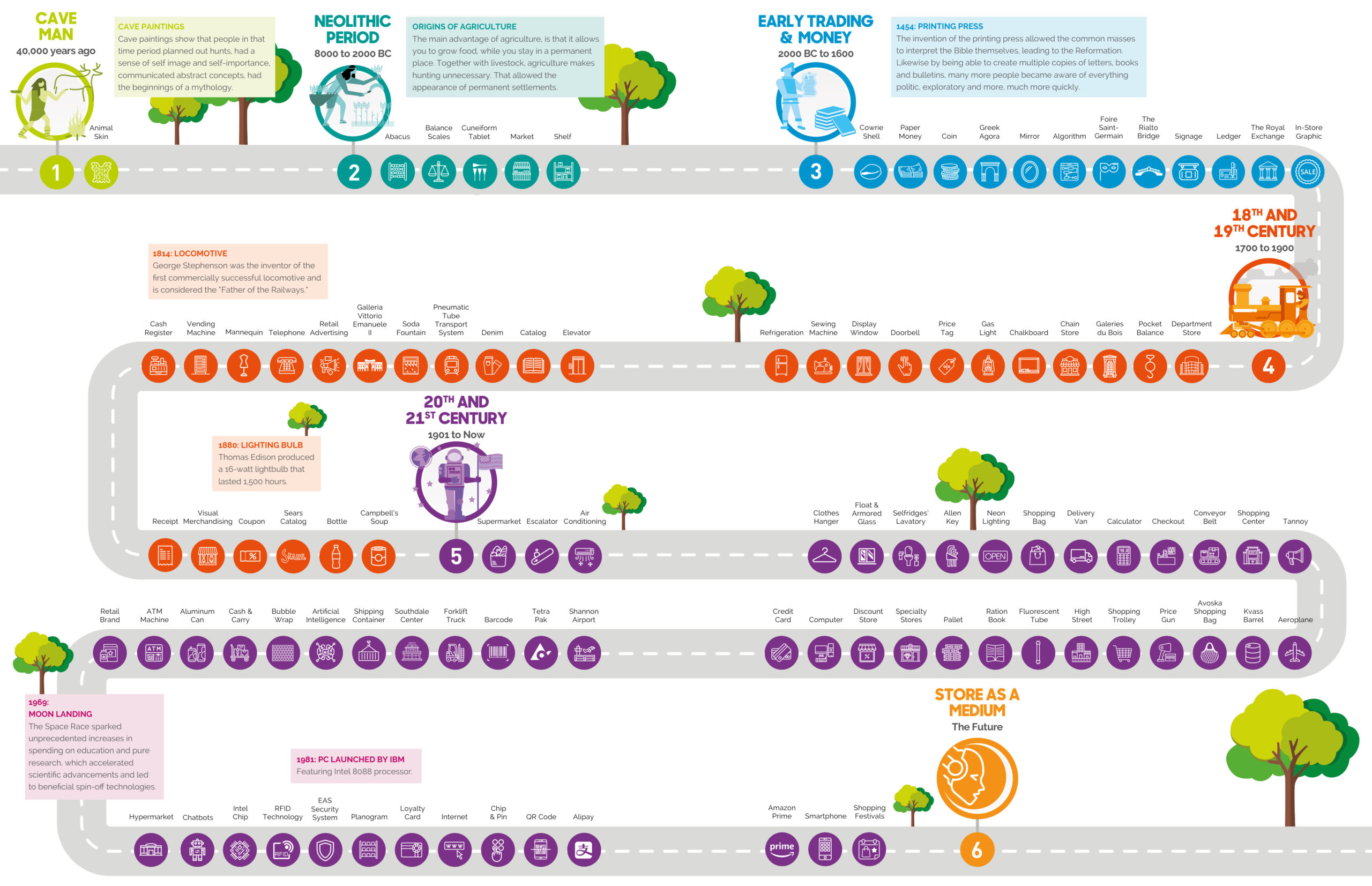
About the series. The History of Retail in 101 Objects is compiled and edited by David Roth, CEO of The Store WPP and Chairman of WPP BAV. It tells the story of retail through the objects that shaped it, from the cave to the connected store, organised across the historical periods in which each innovation made its mark. As David puts it, the history of retail is the history of mankind, and of retail’s vast contribution to society. A new object appears here every Monday.
This is the fourth edition, the World Retail Hall of Fame edition. The book, and every object published so far →