Brands

David has spent most of his life creating, and growing strong, valuable brands that are meaningfully differentiated and grow shareholder value.

In Conversation with Kim Snow-Creative Director at Google


At STREAM Commerce in Miami I interviewed a number of the key speakers and participants as part of my “In Conversation with…” series. I am very grateful to everyone who graciously participated in the recordings and were were so generous in sharing their insights.

Todays “In conversation… is with Kim Snow, Creative Director at Google. Have a good weekend when you get there…


Trust and Transparency – Trend 5

China’s pollution problem has been well documented – a side effect of the tremendous push for economic growth. But Beijing’s recent record high air pollution levels have led to a social media outcry and heightened awareness among consumers of what they buy, where it’s from, and the effect its production has had. Trust and transparency Consumers in China have been on high alert over product safety, especially when it comes to food, since the 2008 scandal in which toxic melamine was found in baby milk formula. That concern over production and point of origin has not gone away, and the uproar over air pollution has intensified consumers’ need to know more about what they’re buying. Imported brands have benefited from this – particularly brands from countries perceived to have clean air, fresh water, and strict safety standards. In the Year of the Rooster, consumer interest in point of origin will go deeper than looking for a flag on a label; shoppers want to know more about the ingredients within products and the entire production journey, right through the supply chain. Environmental awareness and food safety will be hot topics in 2017, and the brands that will win here are those that build safety and the environment into their brand story. Transparency will become a strong selling point.

See The Top 50

Following yesterdays post many people have asked which brands make up the entire top 50, so here you are… a video that gives you the complete run down of our  “BrandZ Top 50 Most Valuable Indonesian Brands 2016”. Video by Tuhin…Nice job Tuhin and thanks. And congratulations to every brand that made the 2016 Indonesian rankings.

Just Launched In Indonesia

BrandZ Top 50 Most Valuable Indonesian Brands 2016 Infographic

BrandZ Top 50 Most Valuable Indonesian Brands 2016 Infographic

The BrandZ Top 50 Most Valuable Indonesian Brands 2016 has just been launched in Jakarta at an event attended by government minsters, business leaders, brand builder and the press. A tremendous job by our BrandZ team. A massive thank you from me to them all. Here is the infographic giving the highlights. You can download it here. Designed by Kay (great job). And yes it has been a while since my last post…and yes it has been very hectic …and yes that’s not really an excuse. More posts to follow…

Pooling Resources – Trend 8

Pooling Resources

Pooling resources One of the ways businesses in China will adjust to slowing economic growth is to focus on efficiency, delivering strong productivity while reducing costs. Crowd-sourcing labour is one way to achieve this, and we expect to see this help fuel agile brands and businesses in the year ahead.

The competitive nature of the in-store environment means brands have had little choice but to use traditional sales and promoter businesses; in a tougher economic climate, the need to connect with stores and consumers is just as important, but the pressure on costs means brands are looking for new ways to achieve this. Crowd-sourced labour – something we’ve seen succeed in many mature markets – is something we expect to see more of in China’s retail industry in the year ahead, particularly in lower-tier cities where there is a hunger for market information but not necessarily the budgets to gather it in the traditional way. Deploying people whose work is paid for in ‘slices’ of time can help give brands a presence in remote places at a very reasonable cost.

This approach has, until now, been mainly used by start-ups trying to minimize their cash burn; this year, we expect crowd-sourced labour to be deployed by more mainstream brands as they work to reduce costs.

The Chinese New Year, known in china as spring festival, is the country’s most important holiday. The Chinese New Year is based on a calendar established about 4,700 years ago. Various legends explain the origin of the Chinese New Year. One describes how people dreaded the New Year because a fearsome beast named Nian annually terrorised the population and devoured children. Then one year a child appeared dressed in red. The beast, frightened by the colour, fled and never returned. That’s why the Chinese New Year traditionally features red lanterns and noisy firecrackers to ward off evil spirits.

The Chinese New Year is based on a calendar that calculates time using both lunar and solar events. Time passes in 12- year cycles, with each year represented by an animal of the Chinese zodiac. Traditionally, people prepare special foods and hope for a future of good luck. They attend many family dinners, starting with a New Year’s Eve feast. Travel home for the family reunion produces a mass migration. The New Year period culminates in the lantern festival, a joyful celebration around the first new moon in the lunar New Year.


Portable Payment – Trend 7

Portable Payments

The role of mobile phones in consumers’ lives will lead to increased use of mobile payment solutions in the year ahead. To meet consumers’ demand for convenience and security, growing numbers of retailers are expected to provide mobile payment options. Accustomed to using mobile phones in every aspect of their lives, consumers in China now want to be able not just to discover products and compare prices on their mobile, but to be able to complete a purchase and pay for it securely without having to look up from their screens. There are huge opportunities for retailers and brands to satisfy this appetite for technology and convenience.

Mobile payment solutions enable retailers to attract new consumers and encourage shoppers to complete a purchase on the spot. The mobile also creates a perfect platform on which retailers can extend their marketing and advertising – and drive loyalty programs. Recent developments in mobile payment include Alipay’s integration into European checkouts, and leading e-tailers developing their own in-house payment solutions, such as Walmart Pay. We expect to see more of these types of solutions in the Year of the Monkey.

These payment solutions have the added benefit of generating valuable data which, when added to the streams of data that retailers already collect, will enable stores to better target consumers with products, services, marketing messages and loyalty offerings that are more likely to hit their mark. All of these pay points are adding to the ecosystem of data and will provide a new axis with which to target consumers, this will shift even more of the control towards businesses like Alibaba and Tencents Wechat.

We see this being a crucial pivot point in the mobile payment power play and perhaps the quickest move away from traditional payment as the resulting data generated from it will increase the influence of those companies that control it

Small-screen social experience – Trend 6

Small csreen China

The rise of mobile commerce is changing not only the way people make a purchase, but also how they research, experience and share information about the brands they consider. Chinese consumers are increasingly sophisticated and technology savvy, and social media content is deepening its influence. Consumers are demanding a more personalized shopping experience both online and in bricks-and-mortar stores. They want great service, they expect products to be available right away, and they want fast delivery. But simply meeting these expectations is no longer enough; it is just the minimum, and there is little margin for error. To mark themselves out among savvy and connected consumers, brands and retailers must now deliver a great experience.

That experience must translate – especially given the growing spending power of the expanding millennial age group – across all platforms. It is now essential that mobile and social media are as seamless a part of the shopping experience as they are a part of consumers’ everyday lives. Content that works on a mobile – from both a function and an engagement perspective – is the first hurdle in the race to deliver a great mobile experience. Demand for more, better mobile content will grow in the Year of the Monkey, driven by the rise in mobile commerce.

This requires a fresh approach to marketing; one that delivers a sense of closeness to the consumer and one that reflects and anticipates the way people use their mobiles to shop. The intimacy with which consumers relate to their mobile phones must translate to the relationships that brands and retailers build and the experiences they deliver.

Chinese New Year Is Approaching

Chinese New Year Celebrations

Apple’s ubiquitous products do not change one iota from market to market.

But they are starting to dabble in limited editions that tap key moments in specific countries consumers lives.

Announced today for Chinese New Year is one such initiative.

Two Apple Sports watches to celebrate Chinese New Year – the year of the monkey. These will be available in China, Hong Kong, Malaysia, Singapore and Taiwan.

Apple CNY Watch

Expect more of this type of activity by manufactures, especially in wearable tech, in the future.

Apple, Selfridges, Art and Branding

Apple Windows at Selfridges

It was odd.

The windows of the iconic department store Selfridges in London were all covered up with Rolex banners so you could not see in.

Then on Thursday all was revealed.

The covers came off. Not a Rolex in sight.

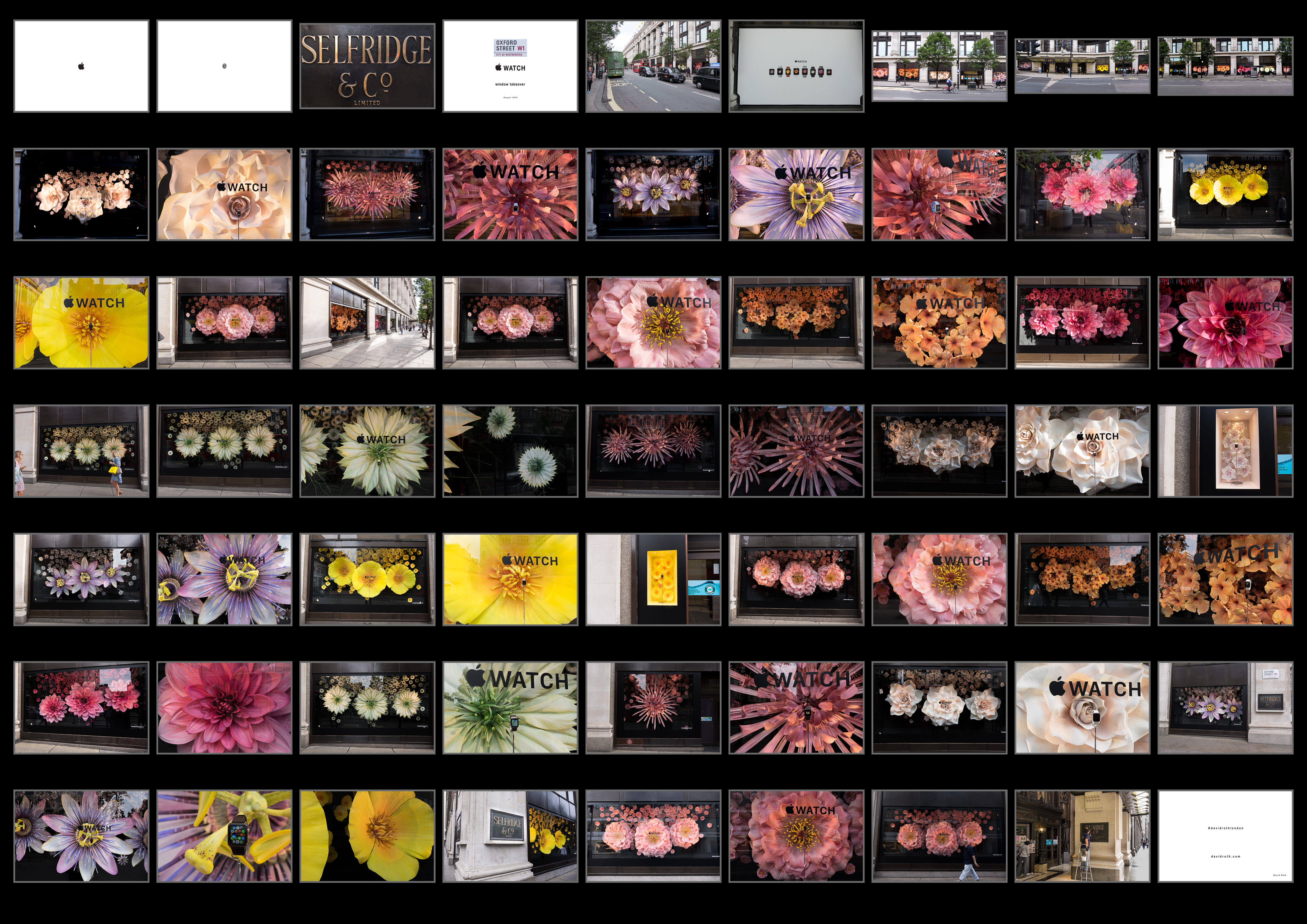
24 windows with a massive Apple Watch installation.

The theme?

Each window has flowers inspired by the flowers on the “Motion” face of the Apple Watch. Each window features an Apple watch as well.

It’s a tremendous, eye catching piece of art and brand experience.

A fusion of art, retail and brand that we should be seeing more of. And judging by the passers by… head turning and stop in their tracks ‘must take a closer look’… staggeringly impactful.

The “flowers” themselves are created through a number of techniques from 3D printing to more traditional resin casting. There are eight different flower variations decorating the windows, each of which was envisioned, scaled, sculpted, and hand-painted by artists. All in all, they created 24 large, 50 medium, 240 “small plus” and 5,525 small flowers.

The effort and attention to detail is paralleled to the original photography Apple used for the creation of their “Motion” watch face. For those flowers Apple shot them as they were flowering in real time. One flower taking 285 hours and more than 25,000 shots.

See all the windows in this on line flip-book and download the window image montage at the top of this post.

Congratulations to each artist involved. You have my respect.

Advertising? Retailing? Brand Experience? Art? …Discuss…


For The Very First Time

http://youtu.be/OKg7kEf7WaU

Just launched in Jakarta, Indonesia. For the very first time. The BrandZ Top 50 Most Valuable Indonesian Brands 2015.

In a transformative time for Indonesian development.

Growth, stability and consumer confidence create perfect conditions for brand building. Indonesia is fast becoming the  economic powerhouse of South East Asia and  in the midst of change on a massive scale.

Now is the time to understand the Indonesian brand landscape better.

Take a look at the top 50 countdown video and download the report from  www.brandZ.com

Prepare to be surprised.